
✦ RPG Resource
Your First TTRPG Night: What Actually Happens at the Table
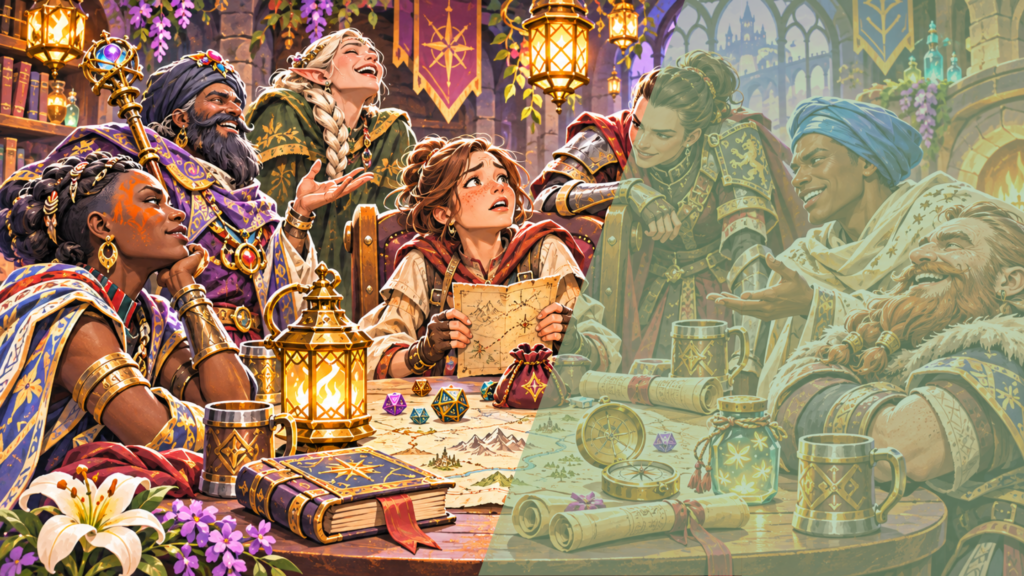
You arrive at your first D&D game night. There are character sheets on the table, dice with suspiciously ambitious numbers of sides, and people discussing a bridge you have never seen. Someone looks up and asks what your character does.
Do you speak? Roll something? Adopt an accent that sounds like a pirate who swallowed another pirate?
That awkward moment is what many beginner guides skip. Knowing what a twenty-sided die does is useful. Knowing what to say when everyone turns toward you is more urgent.
Here’s what a first D&D session involves, what to prepare, and an imaginary hour at the table so you can see the conversation in motion.
What actually happens in your first D&D session?
In a typical D&D session, the Dungeon Master (DM) describes a situation, players say what their characters try to do, and the DM describes what happens next, using rules and dice when outcomes are uncertain. You may talk with characters, investigate places, make decisions together, or fight enemies. You do not need an accent or complete rules knowledge to contribute.
A tabletop roleplaying game, or TTRPG, is a shared game where players make choices as fictional characters and use agreed rules to discover the consequences. Dungeons & Dragons is one example; other games use different systems and customs.
D&D’s 2024 Basic Rules describe a repeating rhythm: the DM sets the scene, players describe their actions, and the DM resolves the results. [1] That rhythm matters more to a newcomer than memorizing a menu of moves.
Every group differs. Some first meetings focus on characters and expectations; others begin with adventure. Our ferry mystery is fictional and deliberately compressed into 60 minutes. It is neither a standard session length nor a record of an actual game.
Before game night: what to bring, ask, and skip
Your first preparation step isn’t buying dice. It’s sending one message to the person running the game:
“I’ve never played before. Is this beginner-friendly, and will you help me learn as we go?”
That’s a reasonable question. StartPlaying, for example, labels games by experience level and advises newcomers to check whether a GM plans to teach beginners. [3] Don’t assume every table offers that support.
Ask whether you need to make a character. A character sheet is a reference page showing what your fictional person can do, carry, and attempt. Some games provide a premade character, or pregen. For a first tabletop RPG session, that might save you an entire evening of debating abilities before your character has opened a single door.
Check four practical details:
- Character: Bring a sheet, use a pregen, or make one together?
- Dice: Bring physical dice, use a digital roller, or borrow some?
- Logistics: Where, when, on which app, and for how long?
- Notes: Is paper or a phone fine for names, clues, and questions?
D&D’s official DM basics mention character records, dice or digital rollers, and notes. [2] None of this requires you to buy a deluxe kit. If playing online, test your microphone first. Future-you deserves a first scene that isn’t a duel with audio settings.
Ask about story tone and comfort boundaries, too. Is the game funny, mysterious, grim, or combat-heavy? Are any themes off-limits? How can someone pause a scene?
Some groups discuss expectations, schedules, and boundaries in a Session Zero before play. Others do a brief check-in. D&D Beyond offers guidance on these conversations, but tables handle them differently. [4] Comfort isn’t an optional feature you earn after learning combat.
What happens once play begins?
Imagine the DM says, “Rain hits the windows of an empty inn. Somebody left a muddy bag by the fire. What do you do?”
You might inspect the bag. Another player asks who owns it. Someone watches the door. The DM responds, a detail appears, and the situation changes.
D&D’s 2024 rules describe three broad activities: social interaction, exploration, and combat. [1] A session might feature all three or spend most of its time on one.
Social interaction means dealing with the story’s people, called nonplayer characters or NPCs. The DM usually portrays them. Ask a ferryman when the last boat arrived, bargain with a merchant, or reassure a frightened stranger. You don’t need to identify a skill before speaking.
Exploration means engaging with places and clues. Inspect footprints, test a bridge, search a room, choose a route. “Can I look under the table?” is a complete contribution.
Combat, when it happens, is more structured. D&D uses initiative to establish turn order, then players use actions and other options to respond to danger. [1] Ask your DM what you can do on your turn. A beginner-friendly table should make that explanation possible.
Describe what you want to try first. The DM decides whether it happens, needs clarification, or calls for a roll. In 2024 D&D, a d20 test uses a twenty-sided die, applicable modifiers, and a target number. Ability checks resolve uncertain tasks; attack rolls try to hit; saving throws respond to threats. [1] Not every conversation or opened cupboard requires dice.
Roleplaying is not an audition
You can say, “Who saw the bell last?” Or say, “I ask the keeper who saw the bell last.” Both are roleplaying. D&D’s rules recognize active dialogue and descriptive narration. [1]
A costume, accent, and dramatic speech are optional. “My character seems suspicious, but I can’t find the words” works, too. What’s important is the choice you make and the space you leave for other players.
A fictional first hour: the missing ferry bell
This is an original teaching example, not an official adventure or actual-play transcript. Imagine a beginner-friendly D&D table practicing for one hour. These minute marks demonstrate different interactions, not a schedule your group must follow.
0–10 minutes: arrive and settle in
DM: “Tonight you’re helping a riverside town. Does anyone want a rules refresher or have a topic they’d rather avoid?”
Player: “I’m new. Can I say what I want to try and ask when to roll?”
The DM says yes, points out key abilities on the sheet, and checks the group’s expectations. One player is a curious traveler; another, a practical guard. Neither needs a two-page backstory explaining their position on soup.
10–20 minutes: the first choice
DM: “Dusk falls over the ferry landing. The night crossing should leave soon, but the brass departure bell is missing. The keeper, Mara, searches under the ticket desk. Wet mud covers the rope posts. What do you do?”
Player: “I ask Mara when she last saw it. My friend checks the posts.”
The DM answers both. Mara heard the bell at noon. Muddy marks lead toward the boathouse. Ordinary questions created two avenues to investigate.
20–30 minutes: talk to somebody
DM, as apprentice Ivo: “I didn’t steal anything. The landing gets muddy after rain.”
Player: “I’m not accusing him. I explain we’re trying to help and ask why he’s worried.”
Ivo glances toward the river. He says the current has been rough since the storm. That’s a clue, not a forced confession. Players can trust him, question him, or investigate elsewhere. Nobody has to act out a convincing interrogation.
30–40 minutes: explore, then maybe roll
DM: “The boathouse door is ajar. Canvas covers a wooden crate. A loose rope lies across the floor.”
Player: “I examine the rope. Is it damaged?”
The DM might request an Intelligence (Investigation) check because the significance of the damage is uncertain. In this hypothetical example only, suppose the DM sets a difficulty of 13. You roll 12 on the d20 and add +3 from your sheet: 15, a success. [1]
DM: “The rope is frayed, and somebody tried to knot it back together. You notice brass glinting beneath the canvas.”
On a failed check, the DM might not reveal the significance of the repair. Checking the canvas could still reveal the bell. Missing one roll doesn’t have to eliminate every path forward.
40–50 minutes: finding it isn’t the ending
DM: “The bell is under the canvas. Ivo appears. ‘I hid it,’ he says. ‘That mooring rope won’t hold a crowded crossing. Nobody listened when I warned them.'”
Player: “Let’s tell Mara, but inspect the mooring first. I want to check his story.”
The group decides whether to return the bell and prepare for departure, delay the crossing to inspect the damage, or ask another witness. The DM doesn’t declare Ivo correct merely because he delivered a dramatic line. The players can verify, disagree, and choose. Their decision matters.
50–60 minutes: consequences and a stopping point
DM: “Mara sees the frayed rope and postpones the crossing while someone fetches a replacement. The passengers grumble, but the ferry stays moored.”
Player: “I tell Ivo that hiding the bell frightened people, but his warning mattered.”
That’s one possible ending if the group checked the rope and delayed departure. Another group might return the bell immediately and face a heated dispute on the pier. The DM follows what the players do instead of handing everyone the same predetermined finale.
The table closes with a quick check-in. What was confusing? What was fun? Would everyone like to play again? In one fictional hour, players talked, investigated, rolled, disagreed, and changed a situation. Nobody fought a dragon. Plenty happened.
Your first-night pocket card
If your mind goes blank when the DM asks what you do, try one of these:
- “What can my character see or hear right now?”
- “I’d like to try something. Would that make sense?”
- “Which rule applies here? Can you show me?”
- “Before we decide, what does everyone else think?”
That’s observation, action, clarification, and teamwork. A respectable toolkit without becoming a rulebook with a pulse.
Before the game, confirm the materials and whether beginner support is available. During play, describe one intention, listen to the response, respect the table’s boundaries, and make a choice that gives teammates room to contribute.
If a long campaign sounds daunting, ask about a beginner-friendly one-shot, an adventure played in a single session. D&D’s rules and StartPlaying both describe the format. [1][3] Confirm its actual duration and expectations before committing.
The real first-session skill
Your most useful ability at a first D&D session is participating in the conversation. You don’t have to deliver an unforgettable speech, master every rule, or solve every problem immediately.
Notice something. Make a choice. Find out what happens.
Our imaginary ferry players asked questions, followed clues, and made a decision together. Your first night might involve goblins, a haunted library, or a fifteen-minute debate about whether a suspicious door is just a door.
That’s the appeal: the next part of the story depends partly on you.
What is the one thing you’d be nervous to ask at your first RPG table? Leave it in the comments.
Frequently asked questions
What actually happens during a first D&D session?
The DM describes situations, players describe actions, and the DM resolves the outcomes. A first night may include introductions, character setup, talking to NPCs, exploring, and perhaps combat. The mix depends on your table. [1]
Do I need to know the rules before my first game?
No memorization marathon is required for a beginner-friendly game. Familiarity with your character sheet helps. Ask whether the DM teaches as you go, because not all groups have the same expectations. [2][3]
What should I bring to my first tabletop RPG night?
Ask the GM first. Usually you’ll want a character sheet or pregen, something for notes, and dice or access to a digital roller. Confirm the meeting details and expected length. Buying supplies may be unnecessary. [2]
How long does a first D&D session last?
It varies. StartPlaying’s June 2026 guidance says most sessions listed on its platform run two to four hours; home games can differ. The ferry’s 60-minute example is a compressed demonstration, not a typical session length. [3]
Do I need to speak in character or use an accent?
No. You may speak directly as your character or describe what they say and do. D&D’s 2024 rules support both approaches. Make a meaningful choice; the voice is optional. [1]
Will my first session include a fight?
Not necessarily. Social interaction, exploration, and combat are major pillars of D&D. Your adventure may emphasize some more than others. If combat occurs, the DM will help explain its turn structure. [1]
What is Session Zero?
It’s a conversation about the group’s play style, goals, schedule, expectations, and boundaries, often before a campaign. Some groups have a dedicated meeting; others discuss it briefly. You can ask about comfort at any time. [4]
Sources cited
[1] D&D Beyond, 2024 Basic Rules, “Playing the Game”: https://www.dndbeyond.com/sources/dnd/br-2024/playing-the-game
[2] D&D Beyond, 2024 DM Basic Rules, “The Basics”: https://www.dndbeyond.com/sources/dnd/br-2024/the-basics
[3] StartPlaying Help Center, “How Do I Know if a Game is Right for Me?” (June 4, 2026): https://intercom.help/startplaying/en/articles/15384861-how-do-i-know-if-a-game-is-right-for-me
[4] D&D Beyond, “How to Run a Session 0 for Your D&D Game” (January 8, 2021): https://www.dndbeyond.com/posts/929-how-to-run-a-session-0-for-your-d-d-game