✦ Article
You Don’t Need a Map of the Entire Kingdom
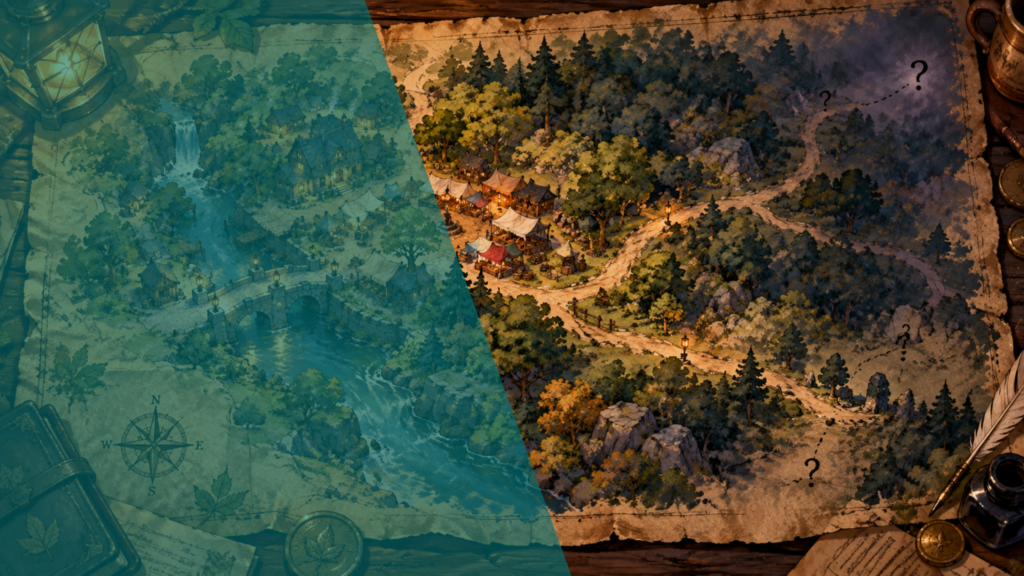
The map looks magnificent. A mountain range winds across the northern edge, three kingdoms quarrel over the river, and a particularly ambitious family tree tells you which duchess offended which duke a thousand years ago.
There is only one small problem: nobody has a reason to do anything in the world yet.
Worldbuilding can be a joy in its own right. If drawing continents is the part you love, please keep drawing. But when the goal is to create a story, a game session, or a place other people can explore, the enormous map can become a rather beautiful detour.
You don’t need the entire kingdom before the first traveler arrives. You need somewhere specific, something unsettled, and a direction the consequences might travel.
Scale is not the same as depth
A large map offers distance. A useful setting offers decisions. “The Western Marches contain seven provinces” tells us the world is big. “The town’s only bridge is locked every winter even though the river never freezes” gives us a mystery worth entering.
Good local details do two jobs. They make a place feel lived in, and they suggest how a person’s actions might matter. A baker who refuses to use the mill has a reason. A bridge watched by nervous villagers has a problem. A little shrine cared for by someone who doesn’t remember its purpose has a question.
You can decide what the distant king thinks later, perhaps after somebody at the table actually asks.
The Three-Anchor Setting: place, pressure, road
Here is a compact approach for making a setting you can use in twenty minutes. It is a Grailwood writing framework, not a universal rule for how all fantasy must be constructed.
Anchor one: one place worth remembering
Choose a village, harbor, woodland clearing, roadside inn, ruined watchtower, or any other location that fits your story. Give it just three sensory details and one ordinary job.
For instance: “Briarford is a river village with bright copper roofs, a mill that smells of warm grain, and a bell that rings once at dawn. People make their living repairing baskets and selling flour.”
Now ask: What do local people protect? It could be a harvest, an old promise, the only dry crossing, or the right to stay. This creates emotional stakes without requiring a global war.
Avoid filling in an encyclopedia. Keep the name, sensory details, and livelihood close at hand. Everything else can be discovered.
Anchor two: one pressure that changes daily life
A conflict becomes interesting when it interferes with something specific. Don’t begin with “ancient darkness returns” unless you know what it means for the potter who opens a shop tomorrow.
In Briarford, suppose the river is dropping despite weeks of rain. The mill slows. Travelers cannot reach the ferry. Someone has started drawing water from a spring that locals once promised to leave undisturbed.
Notice what the pressure gives us: economic trouble, conflicting memories, moral choices, and reasons to speak with people who disagree. We don’t need to know the full truth yet. We do need to know who thinks something must be done and who fears the solution.
Write three viewpoints: a person who wants immediate action, a person who wants caution, and a person who knows something incomplete. That’s enough to create scenes.
Anchor three: one road that invites a decision
The road is the connection between the starting point and the next consequence. It doesn’t have to lead to a capital city. It can lead through a locked orchard, toward a broken standing stone, or across the marsh to someone who remembers the spring’s old name.
Ask two questions: Why would someone leave the safety of this place? What might they discover that changes how they understand the pressure?
For Briarford, the road leads to a grove where a stone channel carries water underground. Travelers could repair a blockage, bargain with a keeper, or discover that the canal was intentionally closed years ago. Their choice can help one group and trouble another.
We now have an adventure seed with real decisions, and we have invented very little geography.
The five-question village test
Try answering these questions aloud, the way a visitor might ask them.
Who would greet me first? What would I notice before I entered? What seems ordinary to residents but strange to outsiders? What is quietly getting worse? Who wants me to do something about it?
If you can answer those five questions with specific details, your world already has handles a story can grab.
If you struggle, don’t make another map. Add a person, object, or disagreement. A merchant who sells bread beside a locked well usually does more storytelling work than another ring of mountains.
A twenty-minute workshop
Set a ten-minute limit for the first pass. Spend three minutes choosing and naming the place. Spend four minutes inventing the pressure and who it affects. Spend three minutes drawing or writing the next road. Use the remaining ten minutes to create two possible opening scenes.
Scene A might begin with a choice: a wagon driver asks for help crossing the bridge before dusk, knowing the town has prohibited it. Scene B might begin with evidence: a child finds wet footprints leading away from the dry spring. Both openings contain a practical problem, uncertainty, and room for a player’s or reader’s agency.
End by writing one sentence of unresolved mystery. For example: “The spring was sealed to protect something, but nobody agrees what it was.”
That is enough material to begin. You can build outward in response to the story’s needs.
What to leave deliberately blank
Leave distant cities unnamed unless their names matter now. Resist inventing a pantheon just to explain one shrine. Keep several accounts of the past rather than presenting every legend as objective truth. And resist answering a mystery merely because you feel uncomfortable leaving space.
Uncertainty can be productive. If a player wonders why the bridge bell only rings at dawn, you can decide whether that detail deserves deeper treatment. If you’re writing fiction, a character’s mistaken account may reveal as much as a perfect historical timeline.
There is a difference between leaving room for discovery and having no internal logic. Keep track of the promises you’ve already made to your audience, especially cause and effect. A simple one-page location note can preserve consistency without hardening every possibility into canon.
When you actually need the kingdom
Broader geography becomes useful when travel, borders, trade, warfare, history, or cultural exchange shape your story. Then expand the map outward from known locations. Let the river lead to the next settlement. Let an argument introduce the neighboring town. Let a character’s errand reveal a mountain pass.
The world grows because somebody has a reason to cross it.
You are allowed to make a big beautiful map. Just don’t require one before your first meaningful scene.
Start with a doorway, a problem, and a road. A whole kingdom may eventually grow around them.