
✦ Self-Help Guide
You Can Love MMOs and Still Be Afraid of Groups
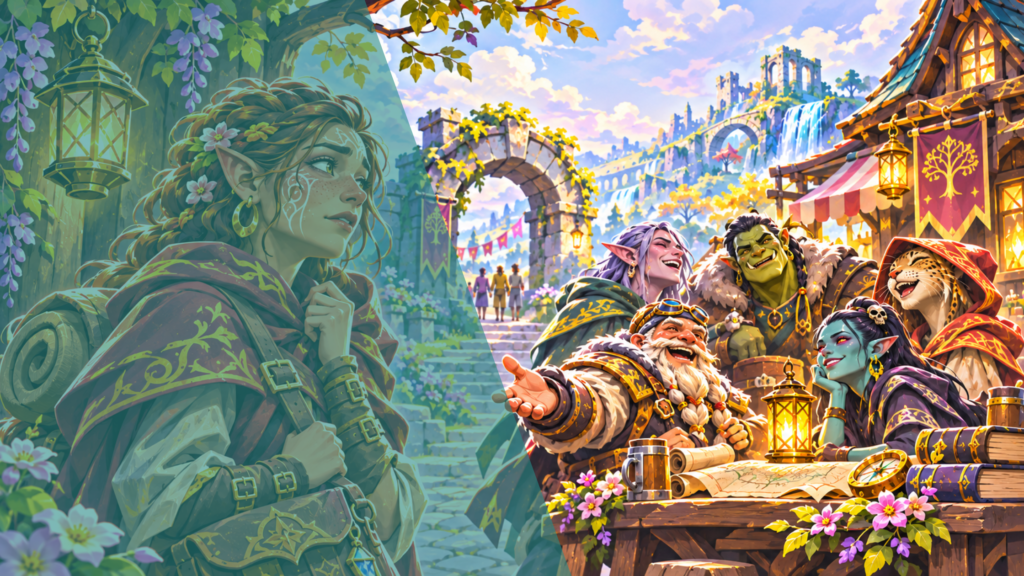
The world is full of people. The cities are crowded, the chat scrolls by, and the dungeon finder promises an adventure with strangers in a matter of minutes. Yet you might spend your evening fishing beside a digital river because joining a group sounds more exhausting than fighting the monster.
There’s nothing wrong with liking solo play. It can be peaceful, absorbing, and deeply satisfying. The trouble arrives when you actually want company but the thought of entering a guild chat or making a mistake in a group keeps you from trying.
You do not need to become the loudest person in the tavern. You only need a doorway that feels manageable, and permission to leave if it turns out to be the wrong tavern.
You can enjoy people without enjoying pressure
MMOs often combine several social demands: unfamiliar mechanics, time expectations, voice calls, performance judgments, and the awkward question of whether you’ll be welcome tomorrow. Different communities make those demands very differently.
Some players love ambitious progression nights and scheduled raids. Others prefer quiet crafting circles, casual roleplay, relaxed dungeon learning, or simply recognizing the same names over time. Neither preference is a better way to play.
Rather than forcing yourself into the most visible or competitive corner of a game, consider choosing environments that match how much interaction feels enjoyable to you.
The Gentle Guild Ladder
This five-rung approach is a set of optional experiments, not a treatment for anxiety or a requirement for becoming a “real” MMO player. Skip, repeat, or stop anywhere. The purpose is to find connection in a way that respects your comfort and other people’s boundaries.
Rung one: observe without auditioning
Spend a short session noticing a community before joining it. Read a guild recruitment post, watch how people respond to beginner questions, or observe a public in-game event.
Look for specifics rather than grand promises. Does the group say what content it plays and when? Does “casual” mean flexible attendance or simply a friendly tone? Do moderators intervene when someone is mocked? Is text participation normal, or is voice treated as compulsory?
You are gathering information about fit. You’re not failing to be social.
Rung two: make one low-stakes reply
Respond to something already happening. “That’s a lovely character outfit.” “Does anyone know whether this event works for low-level players?” “Thanks for the tip about the market.”
A simple, relevant message gives people a natural opening to reply. It is often easier than introducing yourself with your entire gaming history.
If you don’t receive a response, don’t assume the room dislikes you. Chats move fast. People miss messages. You can try another conversation or another group.
Rung three: ask for the kind of company you actually want
When you’re ready, offer a clear, bounded invitation. For example: “Returning player here. I’m learning this dungeon and looking for a patient run sometime this weekend. Text chat works best for me. Anyone interested?”
This asks for help without apologizing for having a life. It states the activity, your experience level, the tone you need, and the communication format.
If you’re searching for a guild, ask practical questions: Is attendance optional? Are beginners welcome in lower-stakes content? Can I join an event without voice chat? What happens if I need to leave suddenly?
Groups worth joining can explain their expectations honestly.
Rung four: try one small shared activity
Choose something with a modest time commitment and a natural exit: a world event, an open roleplay scene, a short dungeon at an appropriate difficulty, or a gathering around crafting. Tell the group if you’re new and ask anything that materially affects the run.
It’s fine to say, “I’ve got thirty minutes tonight, so I can join for one activity but not a long chain.” Keep commitments realistic so you don’t end the evening resenting a hobby that was supposed to be fun.
If a group turns hostile, leaves you unsafe, or mocks reasonable questions, you can leave. A bad match isn’t a verdict on your ability to belong anywhere.
Rung five: reconnect instead of starting from zero
Belonging often grows from recognition. Thank someone afterward. Say hello next time you see them. Share a small resource you found useful. Invite a person you enjoyed playing with to a similar low-pressure activity.
You don’t have to turn every pleasant stranger into a permanent friend. The goal is to make the digital world feel a little less anonymous and a little more hospitable.
Look for welcome signs, not just membership numbers
A large guild can be delightful, but size alone doesn’t tell you whether you’ll find a corner in it. Notice how new arrivals are treated, whether questions receive patient answers, whether people are allowed to miss events, and whether different play styles coexist.
Also notice boundaries. A healthy group can be friendly and still ask members not to harass others, overshare private information, or pressure people into voice calls, purchases, or off-platform contact. Warmth and clear expectations belong together.
Warning signs might include public humiliation, vague demands for constant attendance, pressure to share identifying information, or a habit of blaming individuals for every mistake. You are allowed to keep looking.
If voice chat is not for you
Text chat can be a legitimate and effective way to participate. Some games and activities depend heavily on voice coordination, but plenty do not. Choose suitable content and communicate your preference early so nobody is surprised when a microphone stays silent.
You can use short prepared lines to lower the starting effort: “First time here, happy to follow directions.” “Need a quick break.” “Thanks for the run, heading out now.”
And if you enjoy simply listening while others speak, ask whether the group is comfortable with that arrangement. A welcoming community doesn’t require identical social habits from everyone.
What if you’re happiest alone most of the time?
Then stay mostly solo. Join a festival once a month. Visit public roleplay without joining a campaign. Follow a friendly creator and chat occasionally. Set your own pace.
There is a meaningful difference between solitude chosen because you enjoy it and isolation that leaves you wishing for something else. The only reason to climb another rung is that you want to.
A first message you can borrow
“Hello! I’m returning to the game and playing at a relaxed pace. I enjoy [activity] and usually have [time window]. I’m looking for a kind, beginner-friendly group where questions are welcome. Text chat is easiest for me. Is that a fit here?”
Adjust the message until it sounds like you. You don’t owe strangers an autobiography.
Maybe nobody answers today. Maybe someone points you toward a more suitable guild. Maybe next week you recognize one friendly name in a crowded town.
Not every adventure needs a party. But when you want companions, you deserve a road that makes room for you.