✦ RPG Resource
What’s a D20?
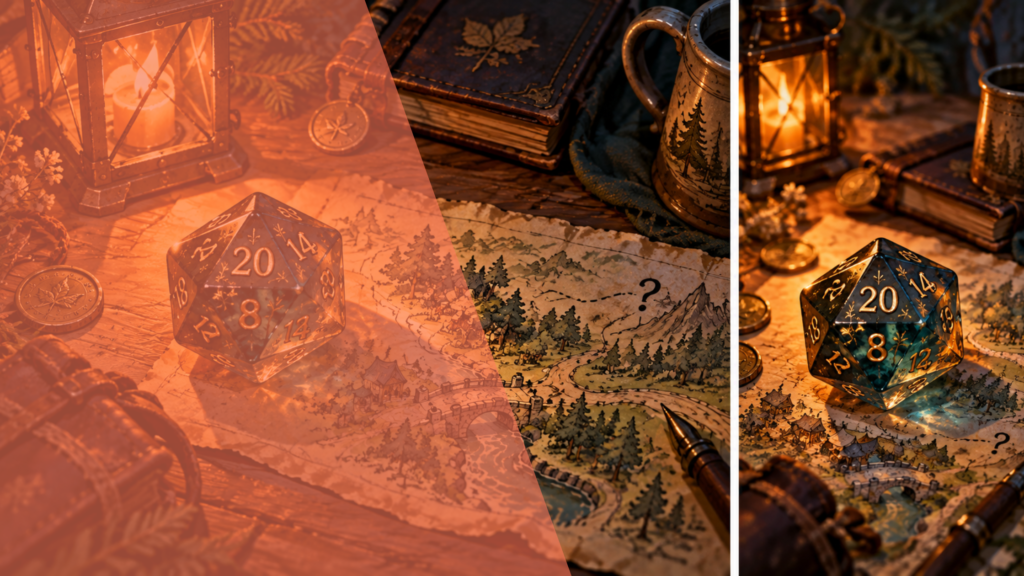
A twenty-sided die looks like something a dragon might keep in a jewel box. It has more faces than most people expect a die to have, and the table often treats it with enormous seriousness.
The good news: it is not complicated magic. In many tabletop roleplaying games, a d20 helps answer a straightforward question: when a character tries something uncertain, what happens?
You don’t need to memorize a rulebook or learn a funny voice to begin. You need a character who wants something, an obstacle worth caring about, and a way to discover the result.
First: what is a d20?
The letter d means die and 20 describes the twenty numbered faces. A standard d20 has faces numbered one through twenty. Roll it and one face lands on top. That’s your starting number.
Different games use dice in different ways. Some use six-sided dice, pools of dice, cards, or no random tools at all. Here we’re using the familiar d20 approach found in Dungeons & Dragons and many other designs.
The current official D&D basic rules describe d20 tests as rolls used for uncertain outcomes, including ability checks, attack rolls, and saving throws. These are distinct kinds of tests with their own rules. For a first example we’ll focus on an ability check: trying to accomplish an uncertain task.
The four-part story loop
One helpful way to remember a d20 is **Intention → Uncertainty → Roll → Consequence**.
Intention: say what you want
“I want to climb the old watchtower.” “I want to convince the guard the letter is urgent.” “I want to cross the slippery bridge without dropping the lantern.”
Start with an action, not a numbered rule. A roleplaying game begins with the fictional choice you make.
Uncertainty: does the outcome need a roll?
If opening an ordinary unlocked door is easy, there’s usually no interesting reason to roll. The door opens; we move on. If the door is swollen shut and a pursuer is coming down the hall, uncertainty creates an interesting moment.
A good roll matters because either outcome changes the situation. Without uncertainty or consequence, dice can slow the adventure down.
Roll: let the die answer
In a straightforward D&D-style ability check, you roll a d20, add a relevant modifier, and compare the total to a Difficulty Class, often called DC.
Imagine the task has DC 12 and your character has +2 from an appropriate modifier. You roll 11. Your total is 13, which meets or beats 12. Success. If you roll 6, the total is 8 and you do not succeed on that check.
You don’t need to memorize all the possible modifiers before your first game. A prepared character sheet or a beginner-friendly game can tell you which number to use. And because different systems have different rules, always follow the game you’re actually playing.
Consequence: tell the next part of the story
The number doesn’t describe the whole scene. Someone narrates what success or failure looks like.
On a success, the character hauls the tower hatch open just before the rain gets worse. On a failed attempt, maybe the latch refuses to move, drawing attention, and the group now has to find another entrance. The die helps decide; the story gives the result meaning.
Three kitchen-table scenes to try
Scene one: the stubborn door
You’re carrying medicine to a village healer. The shed door is swollen shut. You try to force it open. Set an example target of 10 and a modifier of +1.
Roll your d20. If the total is 10 or more, the door opens in time. If not, the door stays shut and the hinges creak loudly. You can now try asking for help, finding a window, or looking for a tool.
This teaches that failure doesn’t have to end the adventure. It can create a new decision.
Scene two: the bridge with a memory
A mossy bridge crosses a stream. It asks every traveler to remember the name of someone who once helped them. You want to interpret the faded inscription to guess what name it expects. For this teaching example, use a target of 13 and a +2 modifier.
On success, you find a clue in the inscription. On failure, the bridge offers a different bargain: promise to repair one missing stone before you pass. That choice might become important later.
This scene shows how dice and story choices work together. The roll isn’t the only thing players can do.
Scene three: the nervous gatekeeper
A lantern keeper is afraid to let strangers into the village at night. You want to earn their trust by explaining what you noticed on the road. Use an example target of 11 and a +0 modifier.
On success, the keeper opens the gate and warns you about the woods. On failure, they ask for a specific proof: perhaps the silver ribbon you found beside the path. That creates another problem to solve, not a judgment about your social skill as a player.
All targets and story outcomes in these three scenes are original teaching examples, not official encounter rules.
Three confusions worth clearing up
Is a high roll always better? In the basic D&D-style checks described here, higher totals help meet the target. But not every tabletop game uses the same mechanic.
Does rolling a 1 mean I fail at everything? Not necessarily. The official D&D Sage Advice clarification distinguishes ability checks from attack rolls: a 1 is not automatically a failure on an ability check under those rules. Individual games and house rules may differ.
Does a failed roll mean I’m bad at the game? No. The roll represents fictional uncertainty. Good decisions can still be unlucky, and a setback can be a fantastic story ingredient.
One final note: real D&D characters have additional rules for ability scores, proficiency, advantage, and more. Those matter during play, but you need not learn them all in the first explanation.
Try one roll without a rulebook
Take any twenty-sided die or use a random number generator that produces integers from one to twenty. Imagine a traveler approaching an old locked greenhouse. Write what they want to do and why it matters. Pick a target number as a teaching exercise. Roll once. Tell two different, interesting outcomes based on the result.
If you’re with someone else, trade places and let them invent the next choice. If you’re alone, write two sentences in a notebook.
You’ve just experienced the heart of a dice-driven story: a decision that mattered, uncertainty you couldn’t fully control, and a new situation to respond to.
The die isn’t the adventure. It’s a small, satisfying way to open the next door.